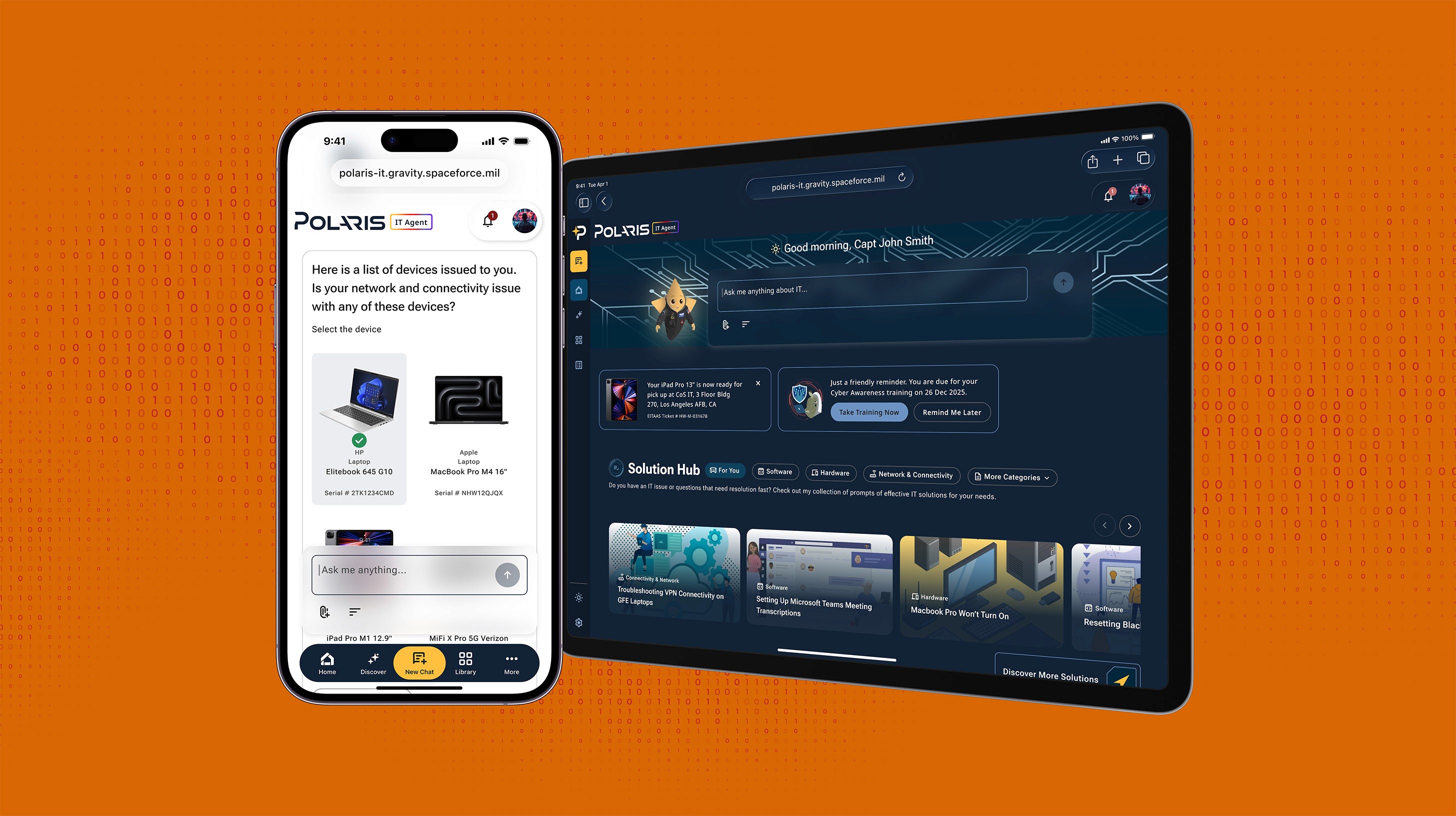
Winner of 2024 Space Force GenAI Challenge, Polaris IT Agent is a personalized AI-powered IT support experience designed to help users troubleshoot issues, access trusted guidance, and navigate complex IT processes through conversational assistance, contextual recommendations, and integrated support workflows.
00
problem
Space Systems Command’s (SSC) IT support environment relied on fragmented systems, inconsistent processes, and manual workflows that made resolving even common IT issues time-consuming and resource intensive. IT customers and support personnel were affected by long resolution times, limited self-service capabilities, disconnected knowledge sources, and growing operational workloads. As a result, IT teams spent significant time handling repetitive support requests instead of higher-impact mission needs, limiting efficiency, scalability, and the organization’s ability to deliver consistent, data-informed IT support experiences.
solution
Polaris IT Agent is an AI-powered IT support platform designed to help Guardians resolve issues faster through personalized self-service support, conversational AI, and trusted knowledge retrieval. By integrating with ServiceNow, inventory systems, and organizational knowledge sources, the platform reduces repetitive support workloads, improves operational efficiency, and creates a more scalable and human-centered IT support experience.
Polaris IT Agent is an AI-powered IT support and self-service platform for SSC, originally conceived as ORBIT—an integrated IT helpdesk and service experience platform—before evolving into an intelligent AI layer designed to integrate with ServiceNow, inventory systems, and organizational knowledge sources to deliver personalized, scalable IT support experiences.
Polaris IT Agent was inspired by firsthand research and observations of the growing challenges facing IT support teams at Space Systems Command. Repetitive support tickets, fragmented systems, inconsistent processes, and limited self-service capabilities created friction for both customers and IT personnel. The project began as an effort to design a more connected and human-centered support experience, and later evolved into an AI-powered platform focused on reducing operational burden, empowering users through self-service, and enabling smarter, more scalable IT support.
As Product Lead and Lead Designer for Polaris IT Agent, I led product vision, UX strategy, AI experience design, and cross-functional collaboration in partnership with the University of Central Florida, mentoring two cohorts of senior Computer Science students to deliver mission-aligned AI prototype capabilities while bridging academic innovation with real-world operational needs at minimal cost.

Research & Discovery
The foundation of Polaris IT Agent began with a large-scale UX research initiative originally conducted under the ORBIT program. The research focused on understanding the end-to-end IT support experience across SSC.
Research Activities
User interviews with military and civilian personnel
Competitive analysis of enterprise helpdesk platforms
Secondary industry research
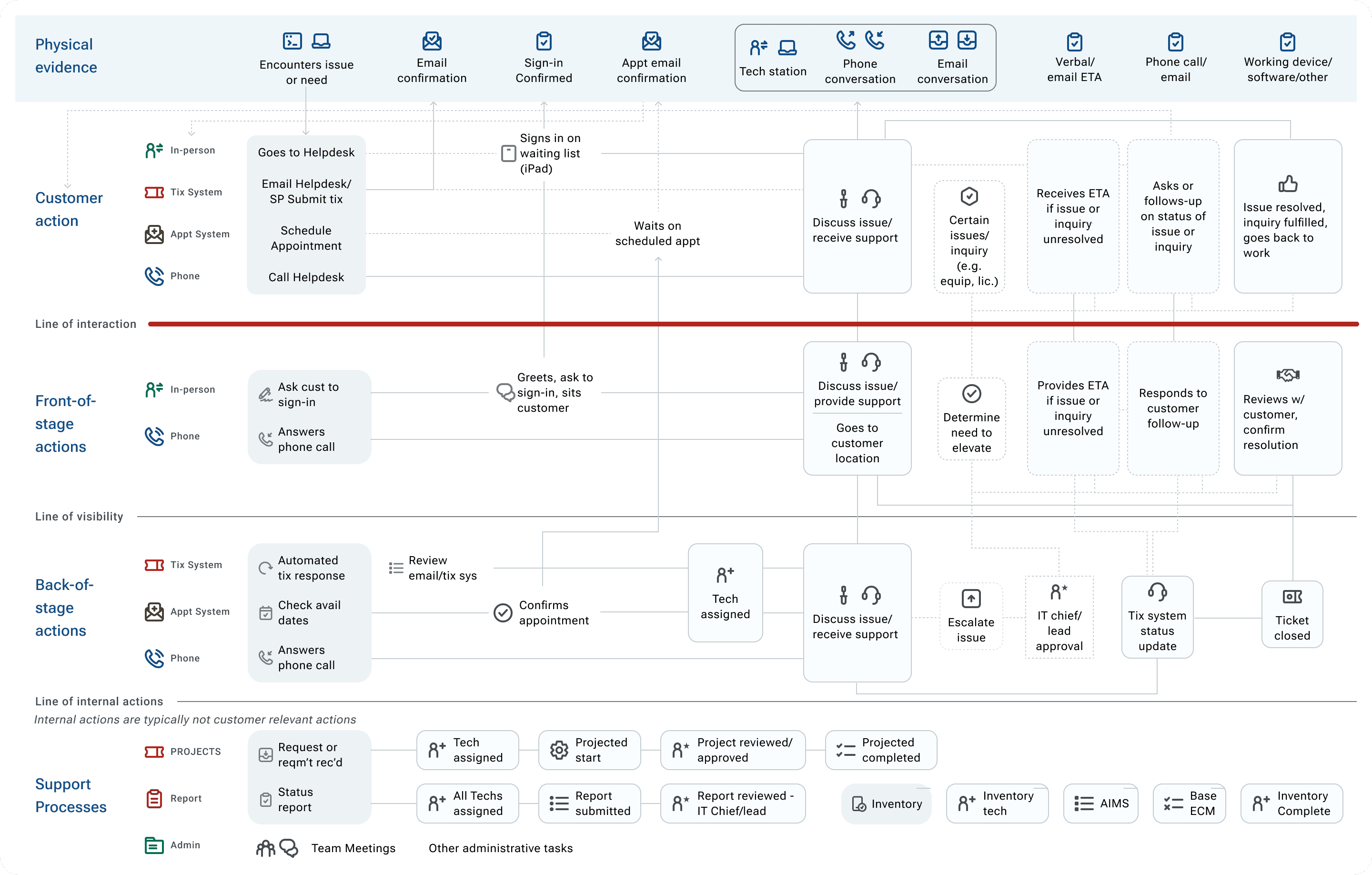
Workflow and service blueprint mapping
Experience pattern analysis
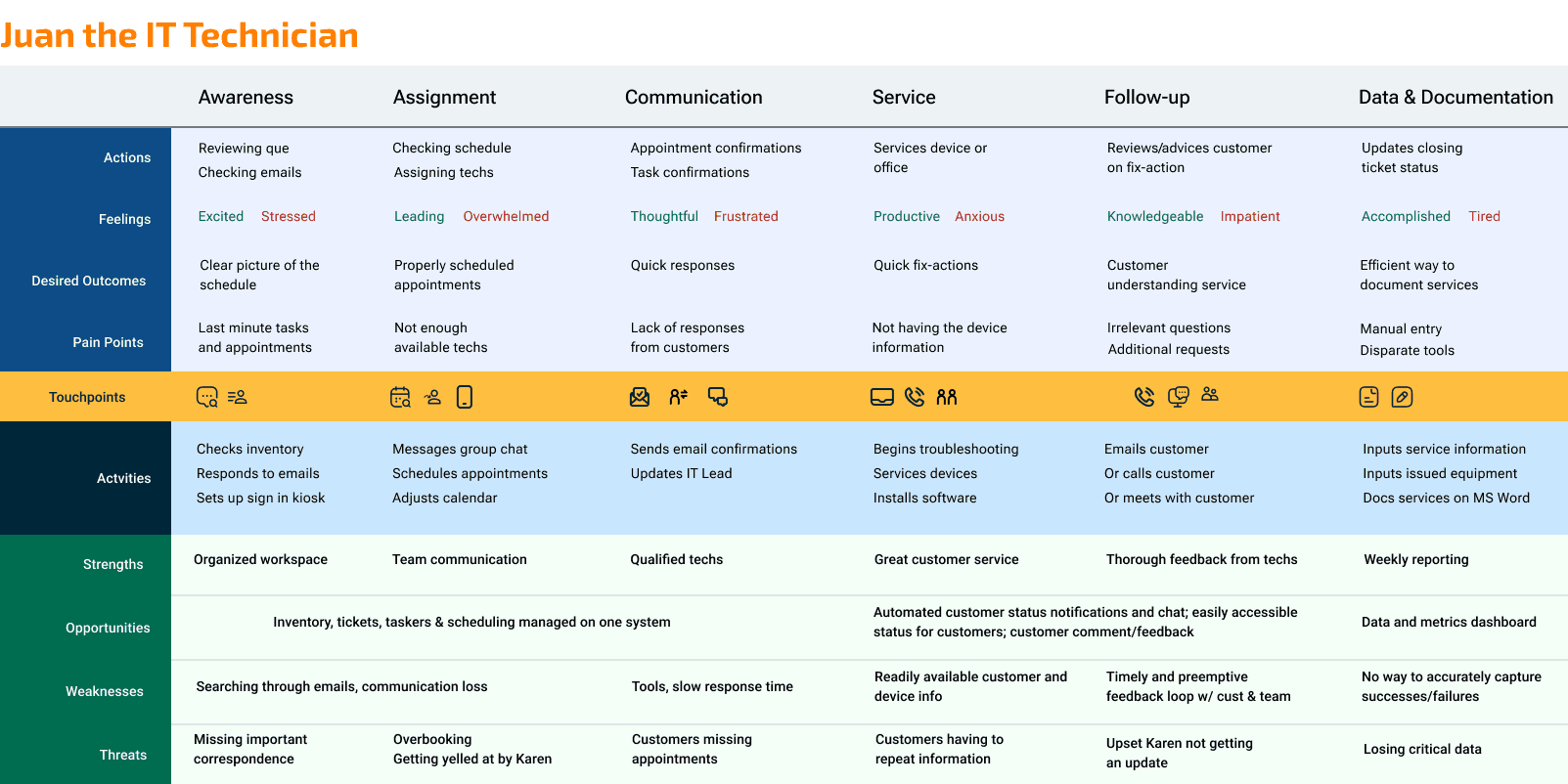
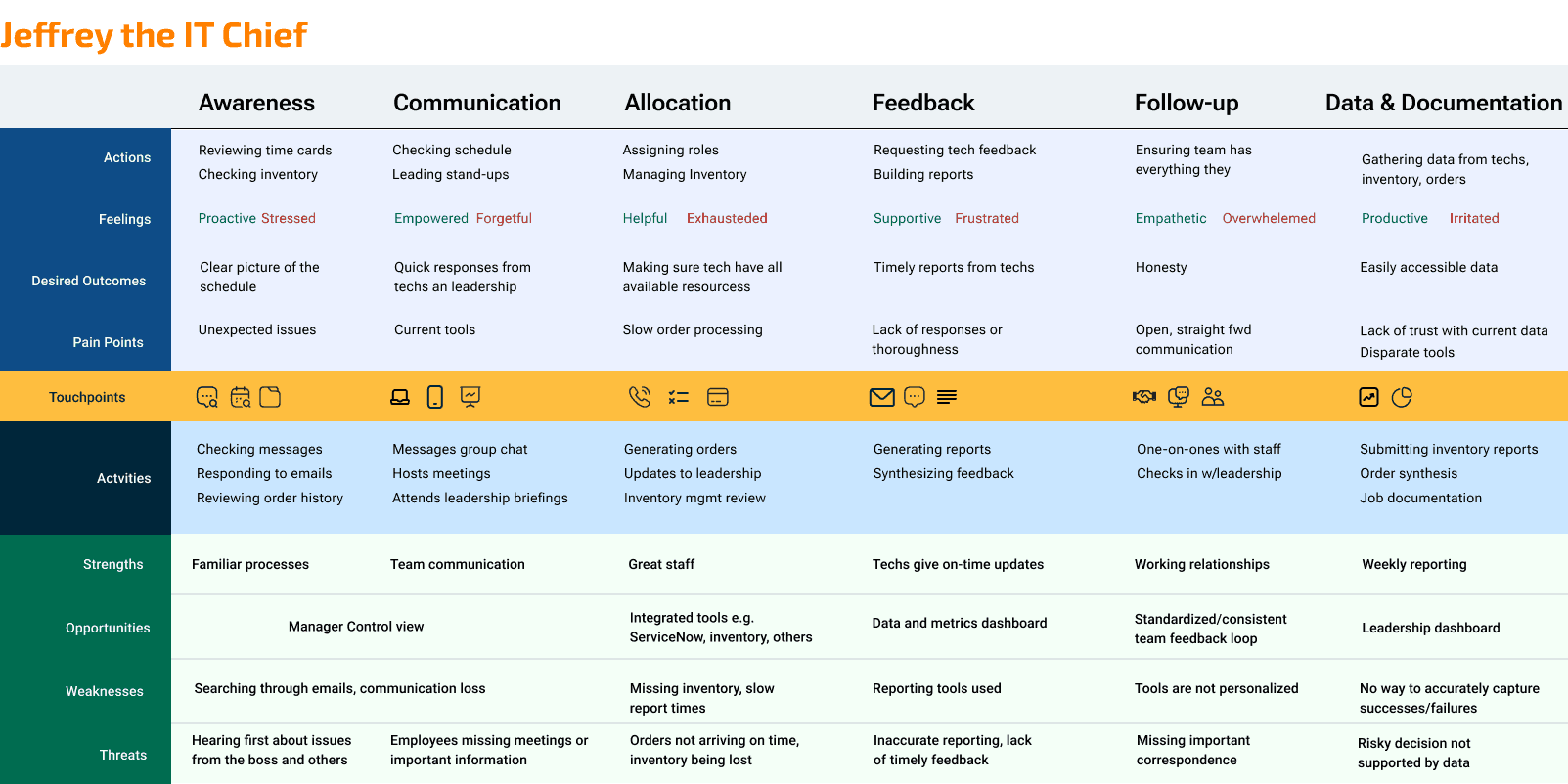
Persona development
Key Findings
Pain Points
Legacy systems and processes
Systems and processes differ by locations and organizations
More work by IT Teams with lesser personel resources
Self-service issue resolution is inadequate and impersonal
Leadership lacks insights needed to effectively manage resources
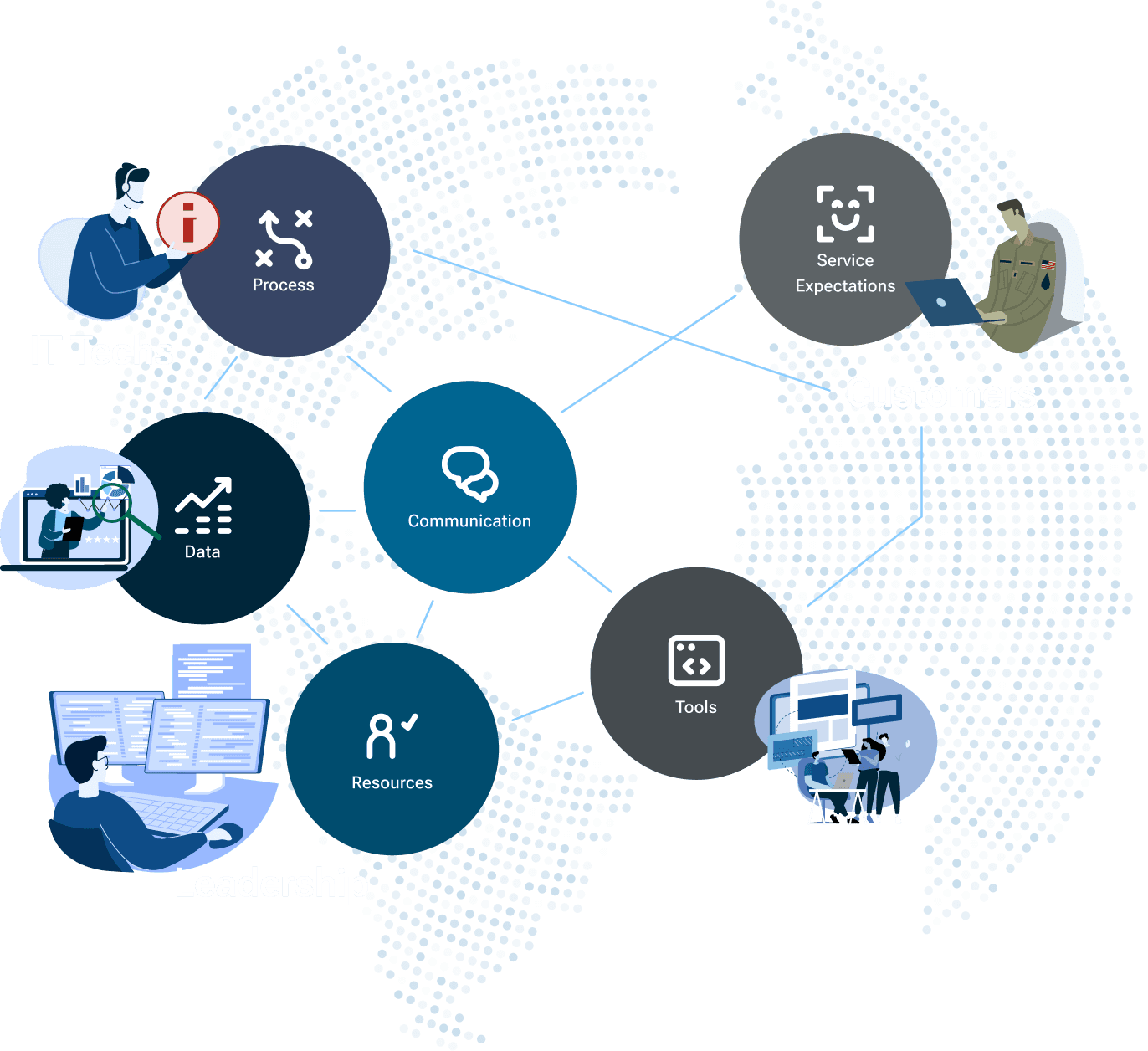
Mundane issues take significant time away from solving high impact issues
86%
IT helpdesk daily ops is handling tickets
74%
Issues are common, simple, and recurring
IT customers are unfamiliar with systems and processes, but want to learn and contribute
87%
Customers prefer self-resolution with self-help guides
Current support model requires more resources than available and necessary
Research revealed that customers did not simply want automation—they wanted:
Faster resolution
Personalized support
Better visibility into issues
Human-centered communication
Self-service learning opportunities
A recurring insight from interviews was that users often preferred researching issues themselves before contacting support.
At the same time, IT teams lacked:
Integrated tooling
Standardized processes
Reliable metrics
Centralized knowledge systems
Efficient resource allocation workflows
Mapping the Current State & Identifying Gaps and Opportunities
Service Blueprint
Journey Maps of Key Personas
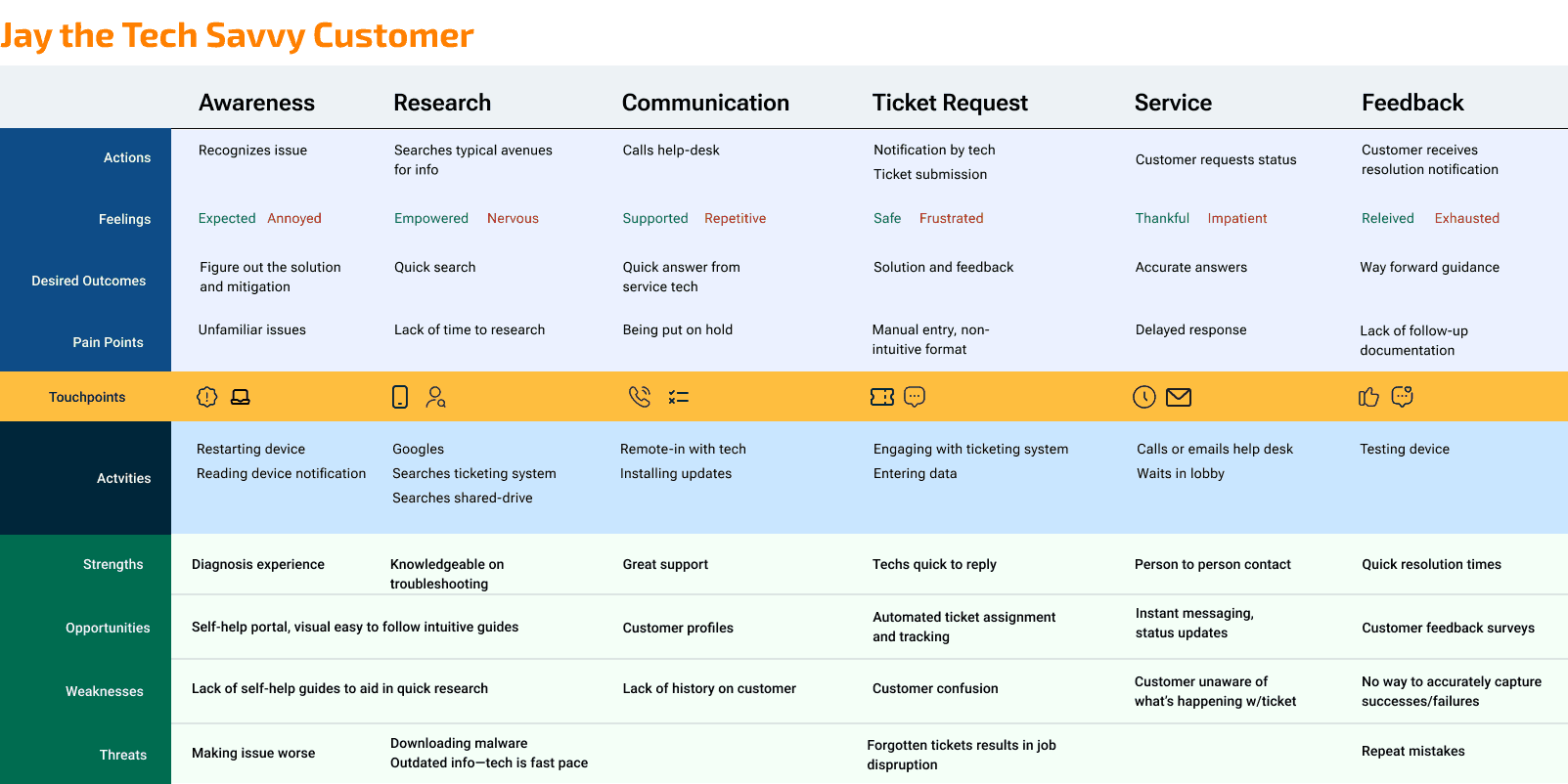
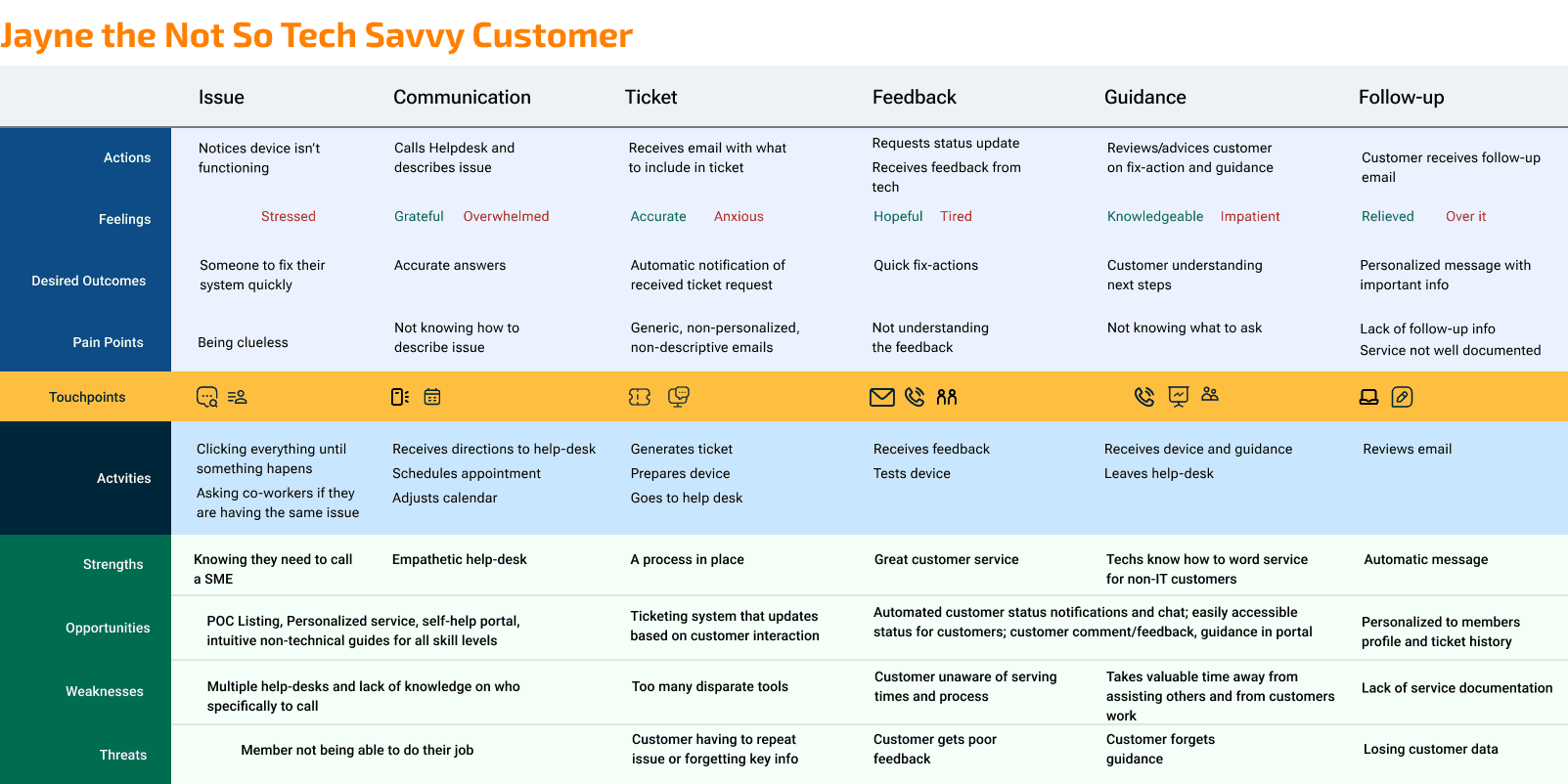
Filling the Opportunity Gap
The product evolved when SSC adopted ServiceNow as its enterprise ITSM solution. Rather than building a competing helpdesk system, we identified an opportunity to create a complementary AI-powered support layer focused on personalized IT customer experiences—leveraging ServiceNow, inventory systems, systems of record, organizational knowledge sources, and operational data to deliver smarter self-service support, contextual recommendations, and scalable AI-assisted workflows. Research findings directly influenced the product direction and AI strategy.
Designing the AI Experience
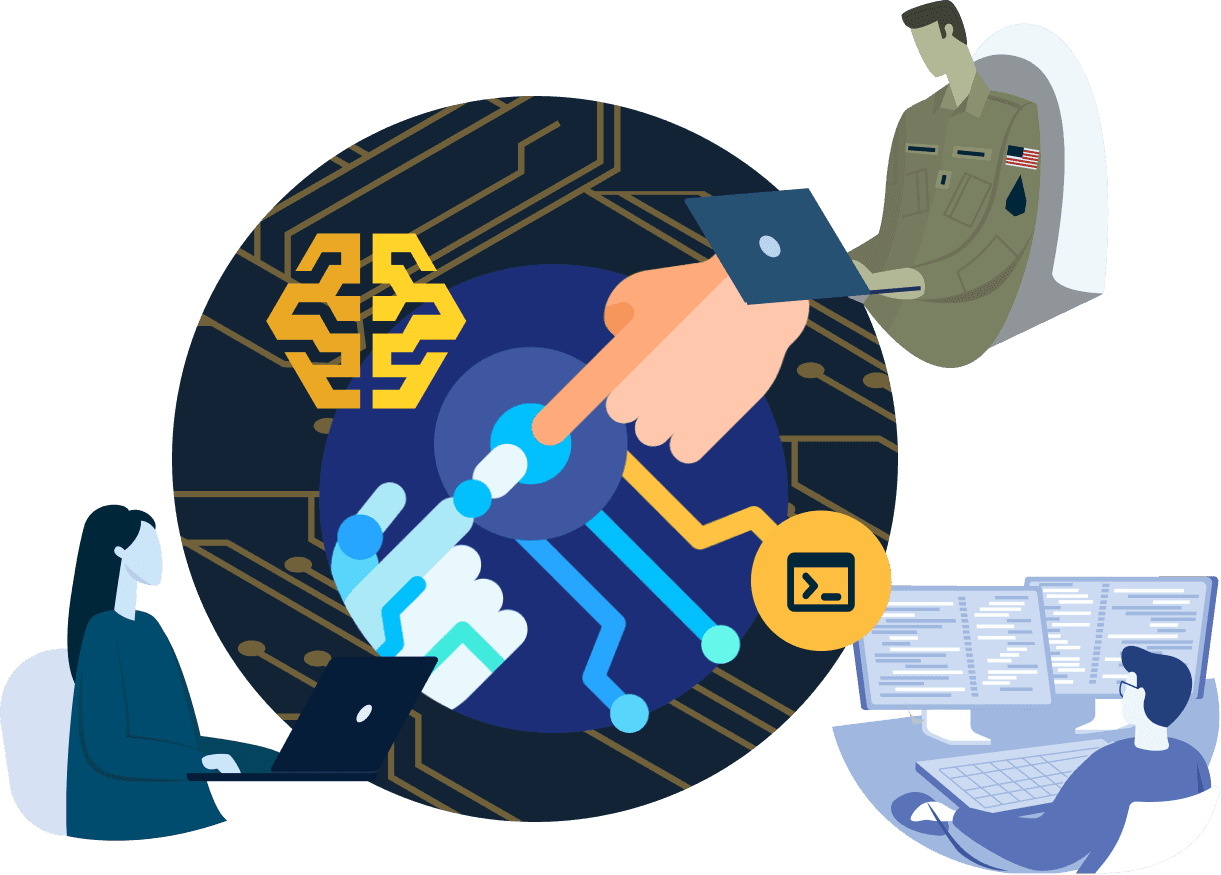
A major challenge was designing AI interactions that felt:
Helpful but trustworthy
Intelligent but transparent
Efficient without removing human oversight
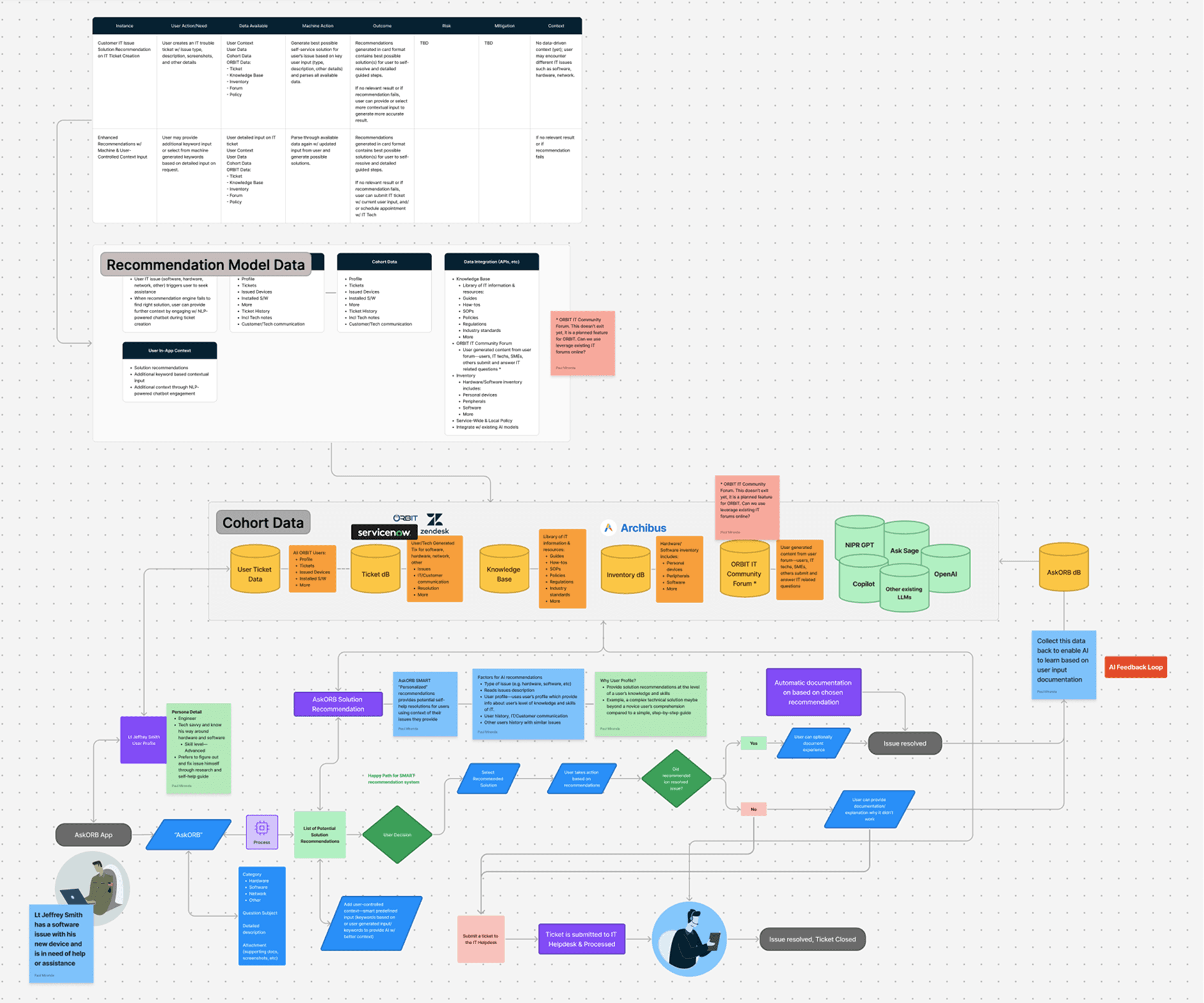
I led the design of:
AI recommendation flows
Escalation logic
Confidence and validation patterns
Context-driven recommendation workflows
Knowledge sourcing structures
Guided troubleshooting experiences
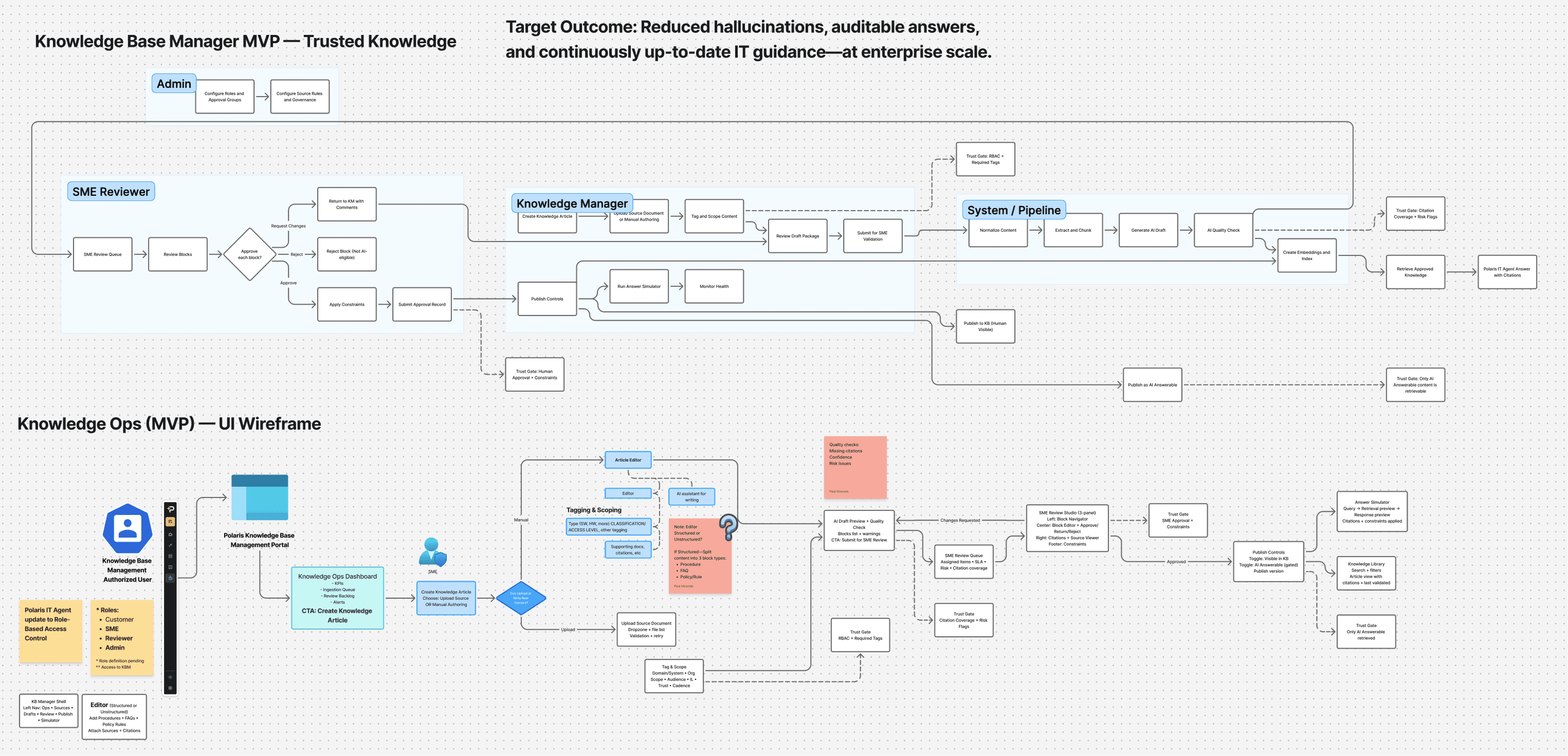
The recommendation system architecture was intentionally designed around explainability and human validation—not black-box automation.
We focused heavily on:
User confidence
Clear next steps
Guided resolution flows
Seamless escalation paths
Reducing friction in troubleshooting
Collaboration with UCF & NSIN
The project was developed in collaboration with the University of Central Florida’s Computer Science Department through the Defense Innovation Unit (DIU) National Security Innovation Network (NSIN) Capstone Program.

Over two cohorts, we collaborated with senior CS students to prototype and expand:
AI support chat capabilities
User onboarding workflows
Knowledge Base Manager
Recommendation engines
RAG ingestion pipeline
This partnership accelerated experimentation while allowing us to validate emerging AI workflows in a mission-focused environment.
Outcomes & Impact
2024 Space Force GenAI Challenge Winner
Polaris IT Agent won the 2024 Space Force GenAI Challenge for its mission-focused application of generative AI in operational support environments.
Strategic Product Evolution
The project successfully evolved from:
Traditional IT portal → AI-powered support ecosystem
Established the Foundation for Polaris
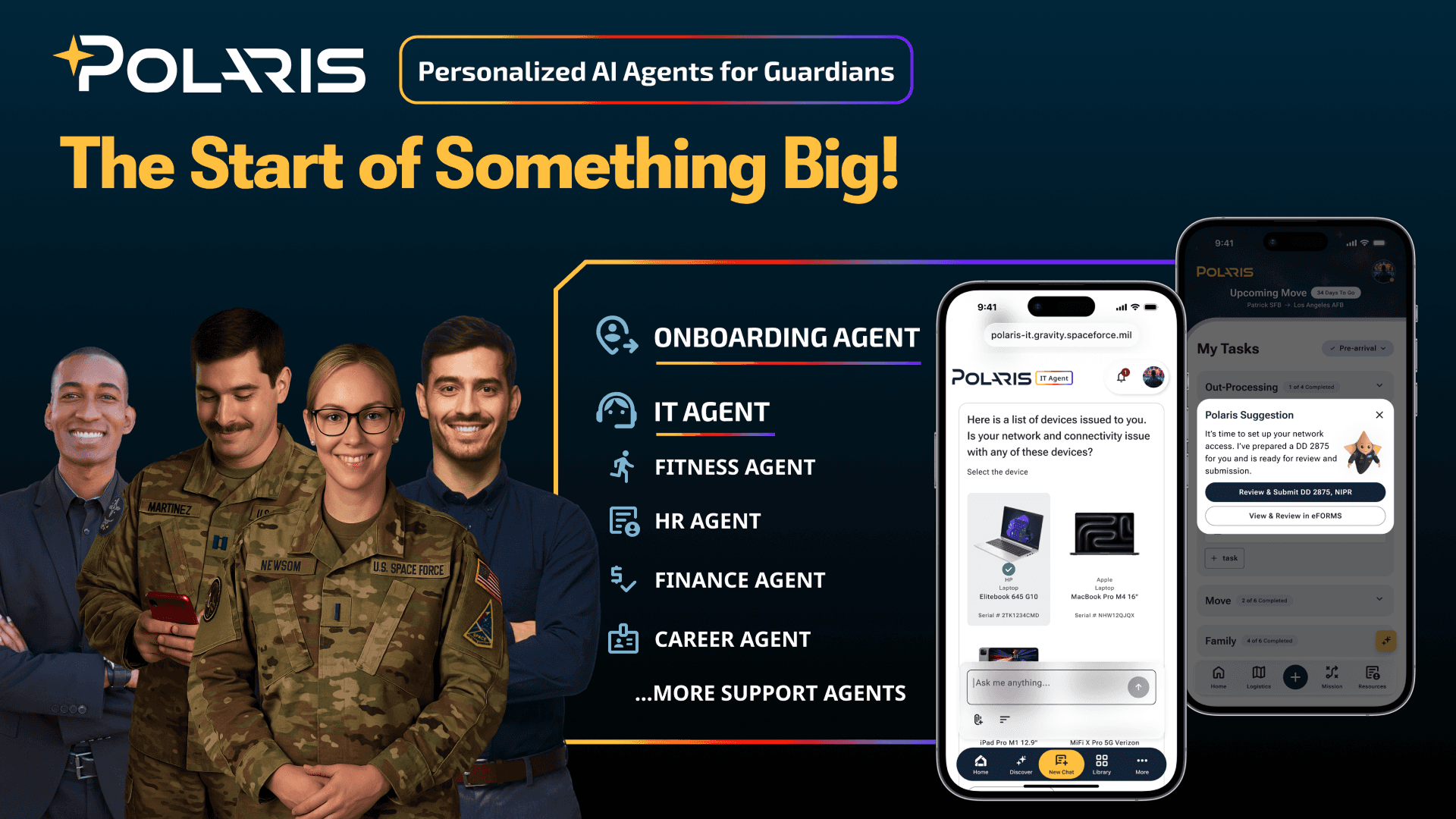
The work laid the groundwork for the larger Polaris ecosystem of personalized AI agents for Guardians.
Built a Human-Centered AI Framework
The product established principles around:
Human validation
Trustworthy AI
Personalized experiences
Explainable recommendations
AI-assisted—not AI-replaced—support workflows
Reflection
Polaris IT Agent fundamentally changed how I think about designing AI-powered products.
The most important lesson was that successful AI experiences are not about replacing people—they are about reducing friction, improving decision-making, and enabling users to operate more effectively within complex systems.
This project also reinforced the importance of:
Designing for operational trust
Building AI around validated knowledge
Integrating AI into existing workflows instead of disrupting them unnecessarily
Treating AI as part of a larger ecosystem experience, not a standalone feature
Polaris IT Agent continues to inform how I approach AI product strategy, agentic systems, and human-centered AI design today.
year
2024
team members
Wuan Perkins, TSgt Lee Harder, Paul Miranda, Theo Titonis, Garrett Zimmerman, Lindsey Slutz, UCF CS Senior cohorts
role
Product Lead & Designer
timeframe
2024 - Active Development
tools
Figma, Figjam, Notion, ChatGPT, Perplexity, Midjourney
01

02

03

see also